
A few dietitians refer to avocados as superfoods.1 This flavorful fruit provides health benefits, such as cholesterol and blood sugar management, because it is a good source of fiber. But when you look at avocado nutrition, you might be surprised.Avocado Nutrition Facts and Health Benefits
Avocados are high in calories, however the majority of those calories are from fat. Does this fruit belong in a healthy, balanced diet, then? Many people do, but if you’re watching your calorie and fat intake, you may decide to consume avocados in moderation.Avocado Nutrition Facts and Health Benefits
Avocado Nutrition Facts
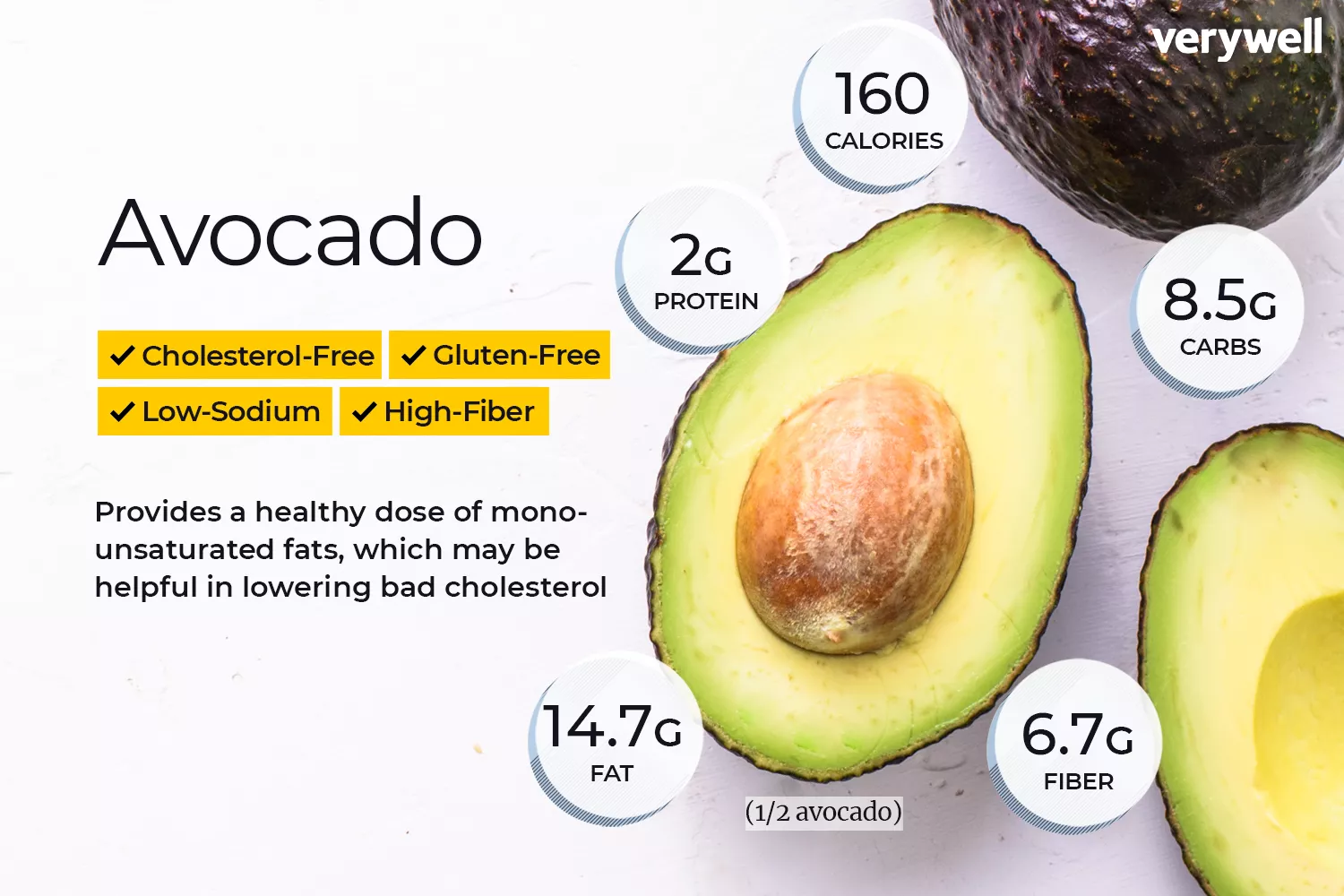
There are 160 calories, 2g protein, 8.5g carbs, and 14.7g fat in one-half of an avocado (100g). Avocados are an excellent nutritional source of magnesium, potassium, vitamin C, vitamin E, and vitamin K. The following nutrition information is for half of an avocado and is provided by the USDA.2
- Calories: 160
- Fat: 14.7g
- Sodium: 7mg
- Carbohydrates: 8.5g
- Fiber: 6.7g
- Sugars: 0.7g
- Protein: 2g
- Magnesium: 29mg
- Potassium: 485mg
- Vitamin C: 10mg
- Vitamin E: 2.1mg
- Vitamin K: 21mcg
Carbs
The majority of the carbohydrates found in avocados come from fiber. A whole avocado has about 17 grams of carbs and 13.4 grams of fiber.2 There is very little sugar in an avocado (less than one gram) and the rest of the carbohydrate in the fruit comes from starch.Avocado Nutrition Facts and Health Benefits
The glycemic index for avocado is estimated to be around zero, making it a low-glycemic food.3
Fats
About 30 grams of fat, 4.2 grams of saturated fat, about 20 grams of monounsaturated fat, and 3.6 grams of polyunsaturated fat are included in one entire avocado.2 So, while most of the calories in an avocado come from fat, they are mostly in the form of healthier monounsaturated fat.Avocado Nutrition Facts and Health Benefits
Plant-based monounsaturated fatty acids, or MUFAs, are liquid at room temperature but begin to solidify when cooled.MUFAs may be helpful in lowering LDL or “bad” cholesterol. For this reason, the Academy of Nutrition and Dietetics recommends that choosing foods with monounsaturated fats instead of saturated fat.
Protein
Half an avocado provides about 2 grams of protein. While it’s not a high-protein food, it can still help you meet your desired protein intake.
Vitamins and Minerals
A slice or two of avocado won’t supply you much in the way of vitamins or minerals due of the modest serving size. But a whole avocado is a good source of vitamins K, E, and C.2 An avocado also contains several important minerals and actually has more potassium than a banana.
Vitamins and Minerals in avocados include:
- Vitamin C
- Vitamin E
- Vitamin K
- Folate (vitamin B9)
- Niacin (vitamin B3)
- Pantothenic Acid (vitamin B5)
- Magnesium
- Potassium
- Copper
- Manganese
Calories
An avocado’s calorie count is influenced by its size.The avocado nutrition facts shown are for half of a medium-sized avocado, but many avocados are smaller and some can be much larger (up to 300 grams or more).
According to the USDA Nutrient Database, there are 322 calories in a larger (200 gram) avocado. In general, an average avocado ranges from 200 to 300 calories.Avocado Nutrition Facts and Health Benefits
If you spread a thin layer of avocado on your sandwich or add a small amount to your healthy taco, you are probably consuming roughly 30 grams or about two tablespoons of fruit.
Summary
Avocados are high in fat, but it’s healthier, monounsaturated fat. They also provide fiber and a variety of vitamins and minerals with very little sugar.
Health Benefits
Because the Hass Avocado Board finances a large portion of the research, avocados have been the subject of substantial study.6 For this reason, it can be tricky to discern whether it is avocados specifically that provide the benefit that is studied. That said, here are a few studies and what they’ve found.Avocado Nutrition Facts and Health Benefits
May Aid in Diabetes Management
Avocados may provide benefits for people with diabetes. Although they have carbohydrates, their low glycemic index rating of almost zero means that they have little effect on blood sugar. The glycemic index is a scale from 1 to 100, with high numbers indicating foods that raise your blood sugar faster.7
Accordingly, people with diabetes can benefit from eating avocados, especially if they substitute them for meals with a higher glycemic index.8 Some studies have shown that avocado consumption is associated with improved glycemic control in subjects with type 2 diabetes.3
Furthermore, a large body of research indicates that type 2 diabetics’ metabolic health may be enhanced by high-MUFA diets.9 For ideas on how to incorporate avocados and other healthy fats into your diet, diabetic cookbooks can provide recipes and other meal ideas for those with diabetes.Avocado Nutrition Facts and Health Benefits
May Support Heart Health
A study published in Journal of the American Heart Association that tracked 110,00 people over 30 years found that those who ate two or more servings (a serving is half an avocado) a week had a 16% lower risk of heart disease and 21% lower risk of coronary heart disease.Avocado Nutrition Facts and Health Benefits
Several studies have also shown that avocado consumption may improve cholesterol levels in some people. Specifically, a 2022 review linked eating avocados with lower total cholesterol and LDL (“bad”) cholesterol in individuals with high cholesterol, a risk factor for cardiovascular disease.11 However, the review authors noted that larger, well-conducted studies are needed.
In addition to exercise and lifestyle factors (such as not smoking and minimizing stress), a healthy diet that includes foods like avocadoes can help support cardiovascular health. Heart health supplements can also be beneficial for those who have a hard time meeting their nutritional requirements through food.
May Prevent Cancer
According to a 2019 review, because avocado seed extract contains more sterol components than the rest of the fruit, it may help prevent cancer.12 However, it is unclear whether it is safe to eat the seed. So, even avocado growers don’t recommend it.13
May Lower Metabolic Syndrome Risk
Researchers examined data from the National Health and Nutrition Examination Survey (NHANES) and came to the conclusion that eating avocados lowered the risk of metabolic syndrome.14 They also noted a connection between eating avocados and better overall diet quality.Avocado Nutrition Facts and Health Benefits
May Promote Weight Loss
Though avocados are high in calories, they still may provide benefits if you are trying to lose weight. The creamy texture and savory taste that comes from (healthy) fat can help you to feel full and satisfied at mealtime.15 Avocados also provide fiber. Eating foods with fiber can promote satiety.
Consuming avocados has been linked in studies to reductions in body weight, body mass index (BMI), and weight circumference.14 A few limited studies have also found that avocados are good for weight loss and regular consumption of avocados may be able to reduce your risk of becoming overweight.16
Allergies
While avocado allergy is rare, research indicates a possible increase in cases of food protein-induced enterocolitis syndrome (FPIES)—a non-IgE mediated allergy that impacts the gastrointestinal tract—with avocado being one potential trigger.Avocado Nutrition Facts and Health Benefits
When eating avocado, those with oral allergy syndrome, also known as pollen-food sensitivity syndrome, may also develop an allergic reaction. According to the American College of Allergy, Asthma, and Immunology, oral allergy syndrome is rarely associated with symptoms beyond the oral cavity, such as hives, breathing difficulty, or anaphylaxis.Avocado Nutrition Facts and Health Benefits
Adverse Effects
Avocados may decrease the effectiveness of warfarin (Coumadin).19 If you are taking this medication, check with your healthcare provider for a personalized recommendation.
Varieties
Many people are familiar with Hass avocados, commonly found at the grocery store. Hass avocados make up 95% of all the avocados eaten in the USA.20 This variety has skin with a dark, pebbly texture. But there are other varieties as well.
Other varieties include Pinkerton, Reed, Zutano, Bacon, Fuerte, and Gwen. Some of these are larger than the Hass and may have thinner, brighter skin. There are 56 types of avocado that come from Florida alone.20
When It’s Best
The avocado tree has a long harvest season that sometimes overlaps from one year to the next, so the fruit can be found in most grocery stores year-round. Avocado doesn’t begin to ripen until it is picked from the tree.20
Storage and Food Safety
To select the perfect avocado, consider both color and texture. First, pick an avocado that is consistently dark in color. Take it in the palm of your hand and gently squeeze it. If it yields slightly, it is ripe and ready to use.
In general, you can store ripe, uncut avocados in the refrigerator for two to three days. If you eat your avocado just a tablespoon at a time, add lime or lemon juice to keep it from browning.
To ripen an unripe avocado quickly, place it in a brown paper bag with an apple or banana for two to three days. You can also freeze an avocado, but it may change the texture of the fruit.
How to Prepare
The hardest part of cooking with avocado can be removing the skin. Use these tips to peel your fruit.
- Start at the top of the avocado and slice it lengthwise from the top to the bottom, then twist it to pull the two halves apart.
- To remove the pit, stick the knife into it and twist it out, then discard it. This should result in two halves with the meat of the avocado unmangled.
- Score the avocado in rows, up and down, and then side to side to make a grid. Now you can scoop out these cubes with a spoon and discard the peel.
- Your avocado cubes are now ready to use.
Sliced avocado is a great addition to a healthy sandwich or wrap. It provides a creamy texture and allows you to eliminate the butter or mayo.Avocado Nutrition Facts and Health Benefits
It’s also great on an English muffin or toast as avocado toast. Many people also add avocado to an omelet, on the side of scrambled eggs, or as an avocado and egg toast sandwich.

